The National Gallery
The great artworks in mankind’s history are on display at The National Gallery. I feel amazed when I am looking at paintings that I have seen on documentaries or read about in the past. The place is huge so a visit can feel overwhelming, so planning ahead can help get the best experience. Almost all the paintings are on Level-2, so head up as fast as you can.
Room 32 in Level 2 would have a lot of the famous renaissance paintings like Caravaggio. Head over to Room 41 for early impressionists like Monet, Degas and Corot. Post-impressionist paintings like Van Gogh can be found in Room 43.All these rooms are roughly in the same area in the gallery. Wander around and you will find hidden gems.
Don’t make the same mistake as me and go to the National Portrait Gallery. We googled some pictures and it pointed us to the National Portrait Gallery and we thought it’s the same one as the National Gallery. They are 2 different galleries, each focusing on a different subject of art.
Here are some of the pictures that I thought were interesting to share
The Execution of Lady Jane Grey – 1833
Paul Delaroche (1797–1856)
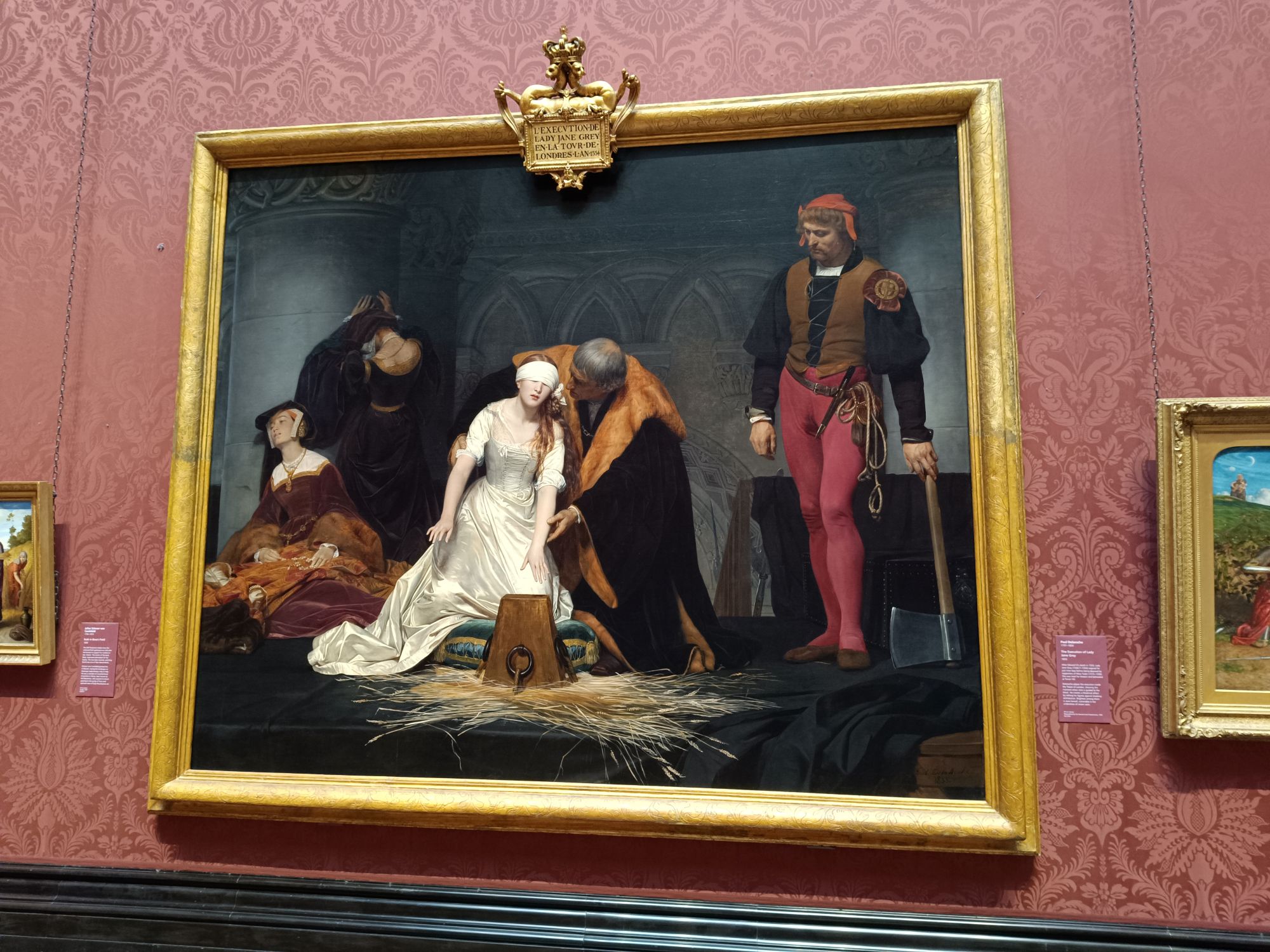
In the catalogue for the 1834 Salon, where the painting was first exhibited, Delaroche quoted from a text about Protestant martyrs, Martyrologe des protestants, which was published in 1558. Describing her final moments, the excerpt tells how the blindfolded Lady Jane pleaded, ‘What shall I do? Where is the block?’ It is this moment that the painting shows, as the helpless Lady Jane is guided to the execution block by Sir John Brydges, Lieutenant of the Tower. Her outer clothing has already been removed and is gathered in the lap of a lady-in-waiting, who has slumped to the ground.
Delaroche uses a dark monochrome background of Romanesque architecture as a foil for the illuminated life-size figures, in particular the group in the centre-right, and the rich reds, browns and blacks of their clothing. Lady Jane is the visual focus of the painting, as the bright sheen of her satin petticoat (its radiant whiteness symbolising her innocence), pale skin and gleam of her wedding ring stand out from the oppressive gloom. No one in the picture looks at us, and nothing, except for the brightly-lit straw laid down to soak up the blood, comes between us and what is about to happen.
Hype about this picture
I feel this painting is made famous from various videos shared on TikTok. The picture was larger than I had expected, as most videos show the picture up close. Worth to spend the time and look through the details of the scene as explained in the placard.
Although not historically accurate in many details, for example, the execution actually took place outdoors not inside, as shown here, the painting’s combination of intense melodrama and realism proved extremely popular with the public. Crowds gathered in front of the picture and pressed forward, eager to get close to it.
More information from the National Gallery website
The Gare St-Lazare – 1877
Claude Monet (1840–1926)
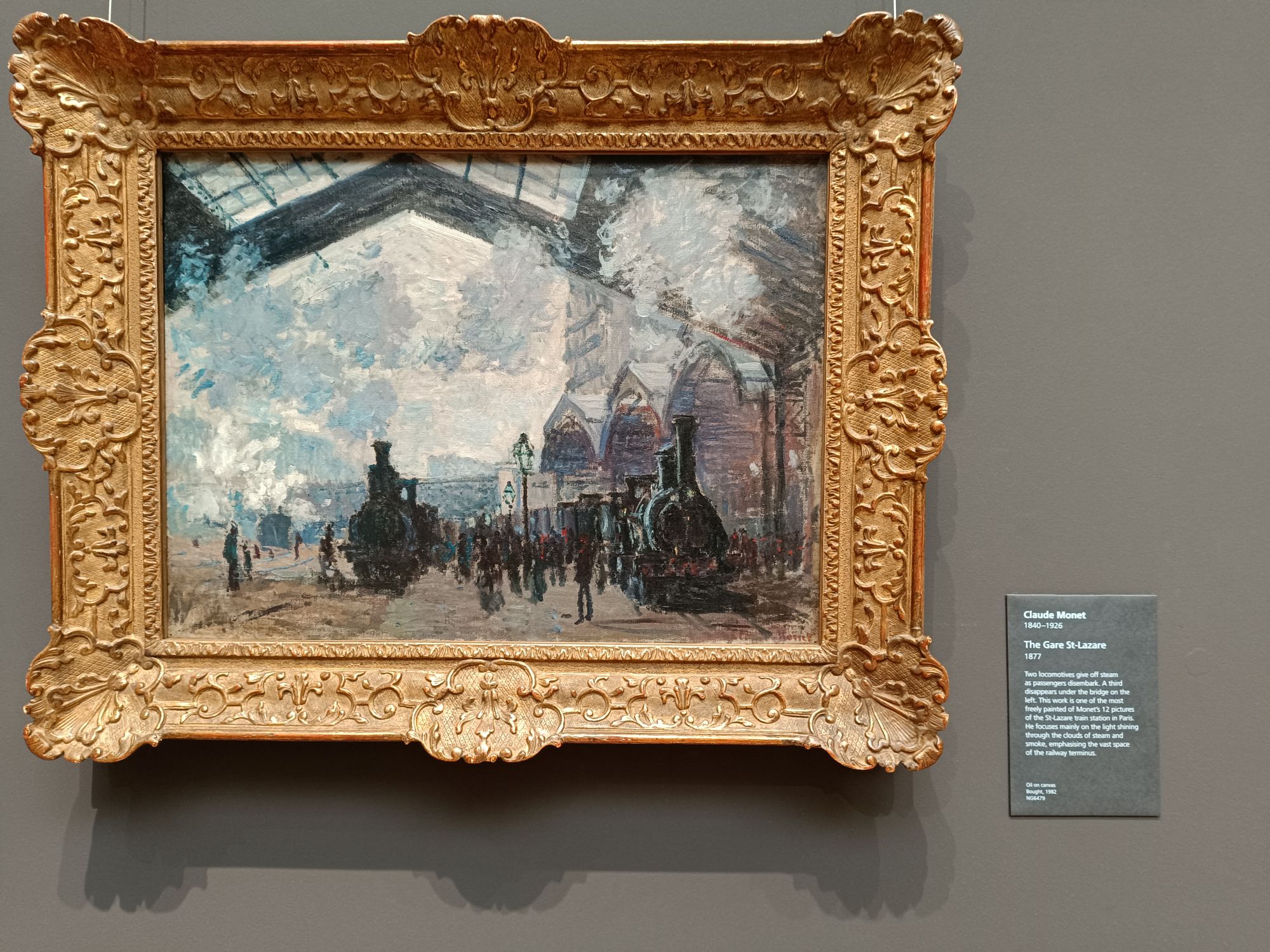
I feel this picture is the one that sticks to my head when people mention Monet. Unlike The Execution of Lady Jane Grey, this painting is relatively small. I can see that most of these impressionist paintings are small and need to be seen from a distance.
Two locomotives give off steam as passengers disembark. A third disappears under the bridge on the left. This work is one of the most freely painted of Monet’s 12 pictures of the St-Lazare train station in Paris. He focuses mainly on the light shining through the clouds of steam and smoke, emphasizing the vast space of the railway terminus.
More information on the National Gallery website
Van Gogh’s Chair – 1888
Vincent van Gogh (1853–1890)
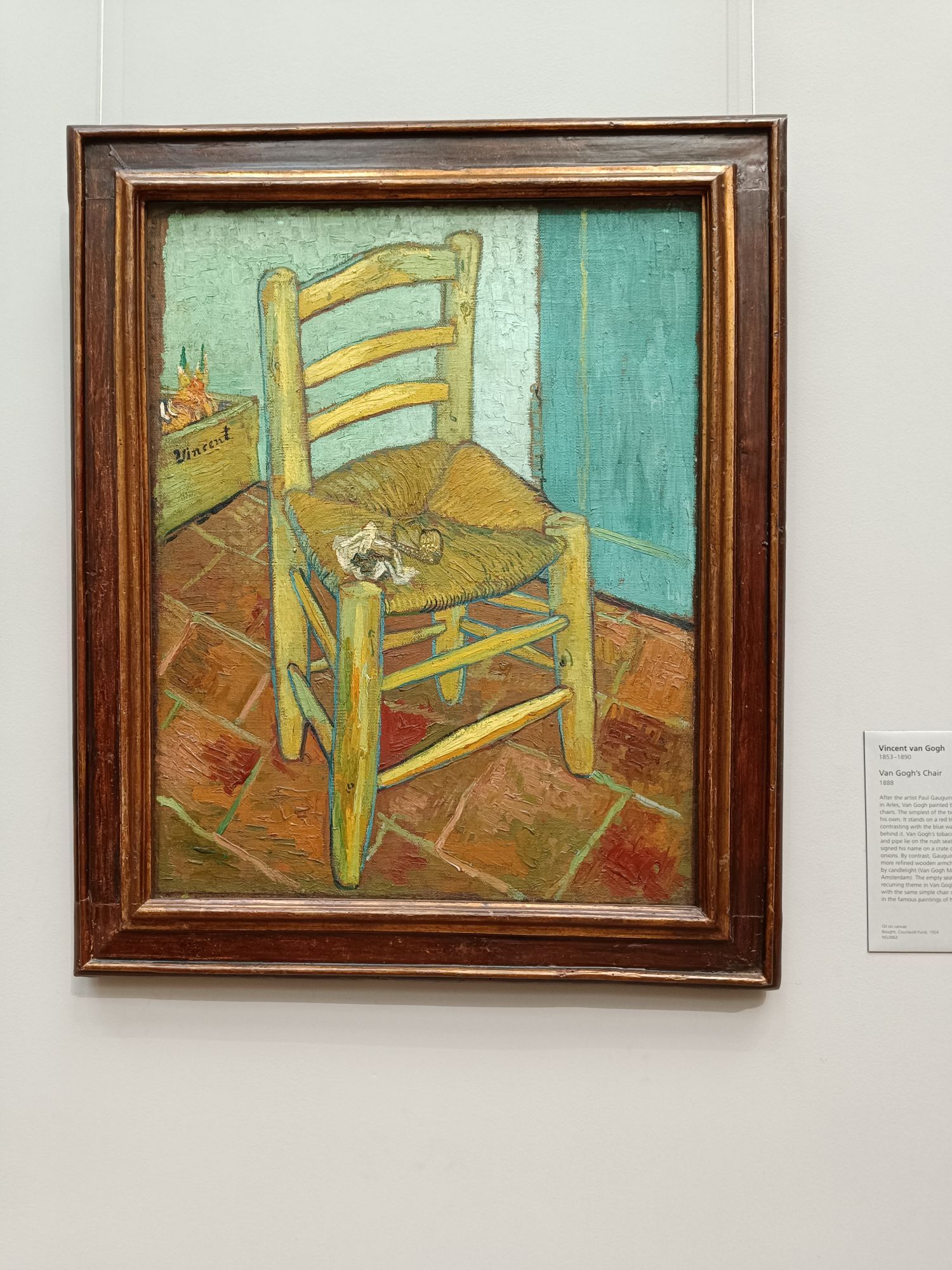
We were hoping to see Van Gogh’s sunflower but it was on display elsewhere at that time. The other painting that I associate with Van Gogh is the picture of his chair.
Van Gogh painted this work during his time with Paul Gauguin in Arles, featuring a simple chair on a red tiled floor that contrasts with a blue background. The painting includes a pipe and tobacco pouch on the seat, along with a signed crate of onions. This image is a companion piece to a painting of Gauguin’s chair, and the same simple chair appears in Van Gogh’s paintings of his bedroom.
Salome Receives the Head of John the Baptist – 1609–10
Michelangelo Merisi da Caravaggio (1571–1610)
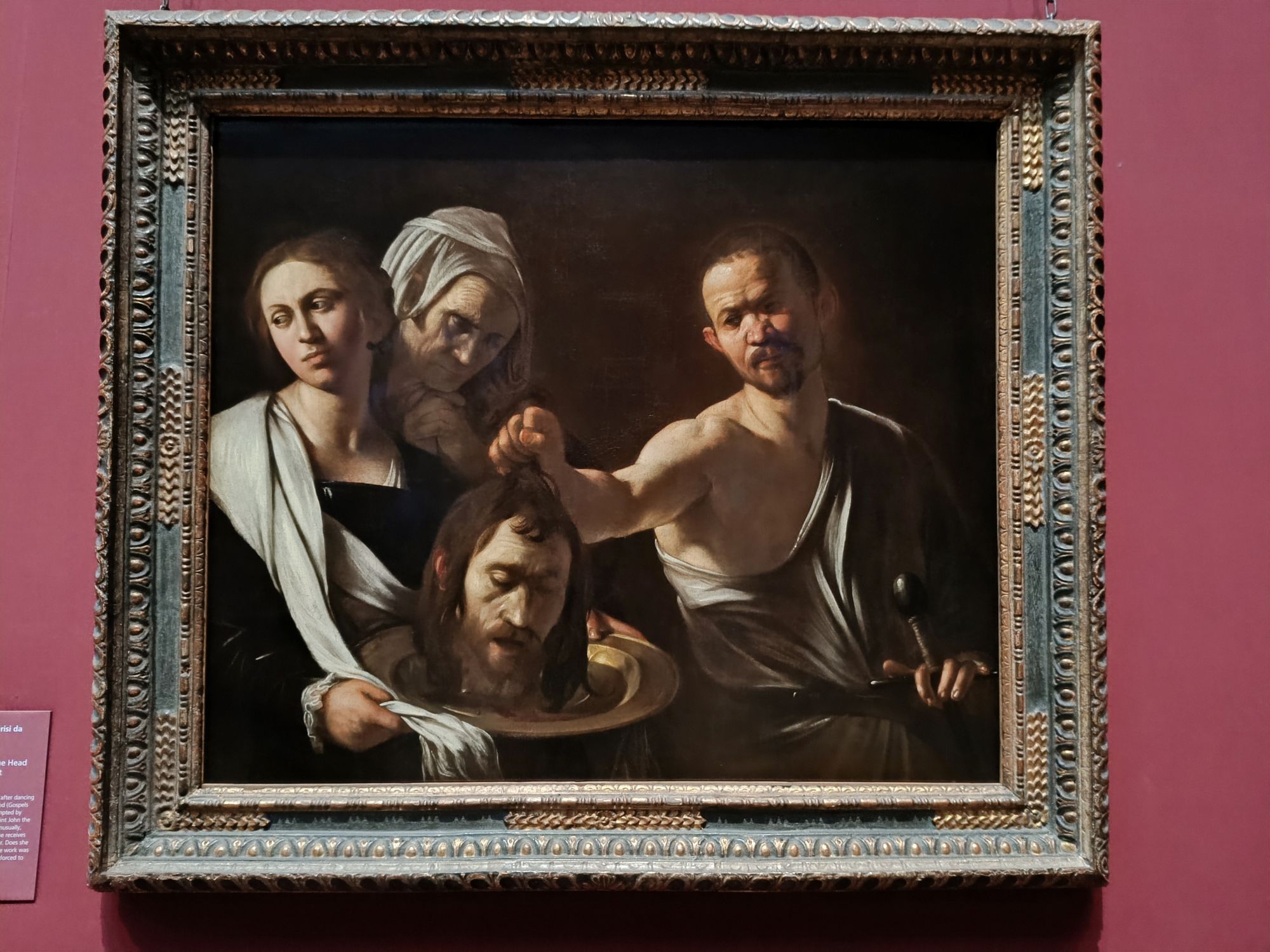
My friends say I have an obsession with Caravaggio paintings. I am mesmerized by his use of dark background and light that shines at the subject of his art. This painting is one of his more famous ones, depicting a scene from the bible.
Salome was granted a wish after dancing for her stepfather, King Herod (Gospels of Matthew and Mark). Prompted by her mother, she asked for Saint John the Baptist’s head on a platter. Unusually, here Salome turns away as she receives the head from the executioner. Does she feel disgust or regret? This late work was painted after Caravaggio was forced to flee Rome for killing a man.
The Ambassadors – 1533
Hans Holbein the Younger (1497/8–1543)
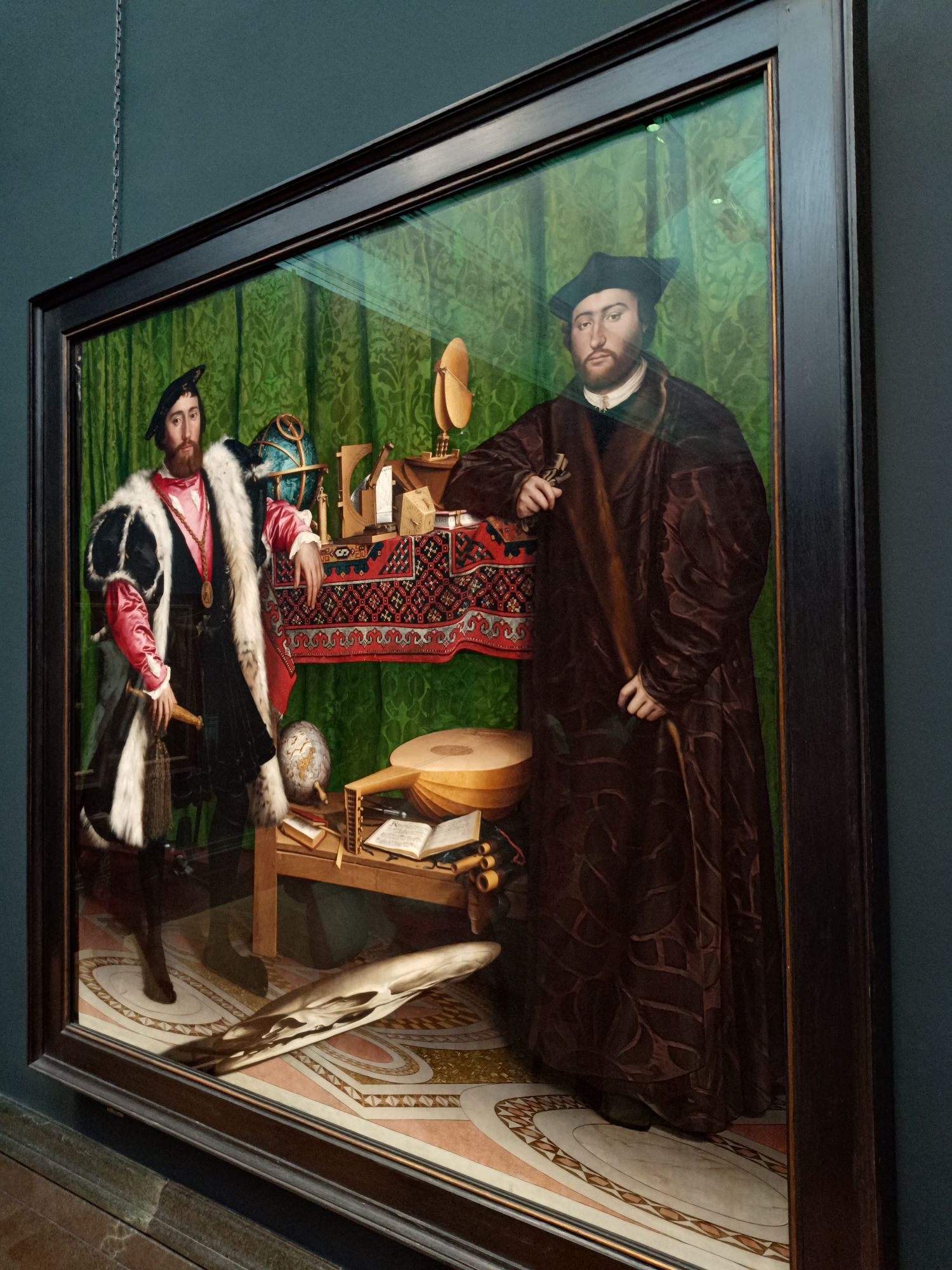
I would not have known about this painting had it not been for TikTok videos. Needless to say, there is a crowd around this painting. People are trying to take pictures from different angles to see the skull on the painting.
This double portrait celebrates friendship. Holbein painted the French diplomats Jean de Dinteville (1504–1555) and Georges de Selve (1508–1541) during their mission to England in 1533, as King Henry VIII was breaking with the Church of Rome. The rich setting proclaims the sitters’ splendour and learning. However, the lute’s broken string and the miscalibrated scientific instruments suggest the turmoil of that time.
Viewed from the right, the distorted grey shape is revealed to be a skull, a powerful reminder of death. By contrast, the small crucifix at top left hints at the hope of everlasting life through Christ.
Roald Dahl, 1916–90
By Sir Matthew Smith

Like I said earlier, we went to The National Portrait Gallery first. While we were there wondering where the paintings of great artists were, I came across a portrait of this handsome young man. I had to read a few times to make sure this was Roald Dahl. This painting is in the Portrait Gallery, which is different from the National Gallery. They are both beside each other but have different entrances. We know Roald Dahl from his books, so it did not occur to me that he lived during the WWII era.
During the Second World War, Roald Dahl was a Royal Air Force (RAF) pilot. This portrait was painted before he embarked on his career as an author. Dahl fell in love with Smith’s work after seeing his paintings in London and sought him out, appearing at his doorstep in uniform. This was poignant for the artist whose two sons had recently been killed while serving in the RAF. Dahl and Smith then became firm friends. Dahl became widely celebrated for his enduringly popular books for children, including Charlie and the Chocolate Factory (1964) and Matilda (1988).
Getting there
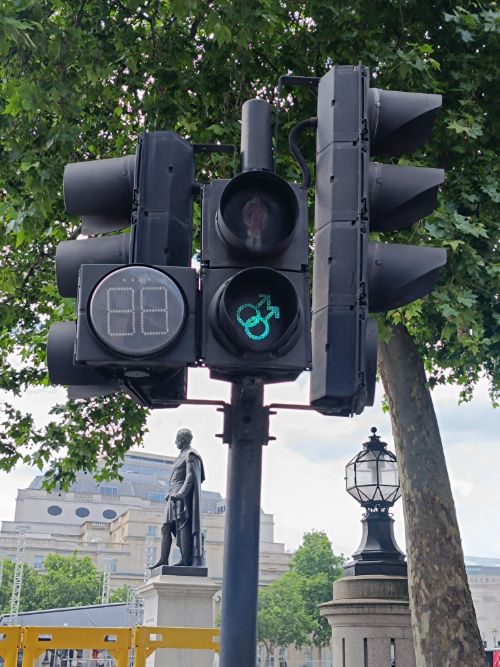
Easiest is to stop at Charing Cross Station. There are signs in the station that will point to the right exit to the galleries. It’s not a long walk from the station. Once you come out from the right exit (we came out from exit E) you can see Nelson’s column and Trafalgar Square. That’s where the galleries are located.
Get more insights in our London itinerary